

External examiners: nomination
Appointment of external examiners
Period of appointment
External examiners are normally appointed for four annual assessment cycles, usually covering four years.
In exceptional circumstances, an appointment may be extended by up to one year. An extension may be appropriate when a programme is ending and the existing external examiner needs to see it through to completion. This helps maintain the quality of provision for the remaining students.
Requests for an extension must include a clear rationale and be submitted in advance to the AQS Quality Manager (Externality) for approval.
External examiners should normally hold no more than two appointments for taught programmes at any one time.
The University applies specific appointment criteria for all external examiners. These are based on national criteria.
Criteria for appointment of external examiners
Previous involvement in the validation or review of a programme does not constitute a conflict of interest. A person who served on a programme’s validation or review panel may therefore be nominated as its external examiner.
External examiners should normally be in post before the annual start date of the programmes for which they are responsible.
Appointments should be approved as early as possible in the academic year. Approval must take place before the current external examiner completes their term or before the first start date of a new programme.
Nomination and Appointment process
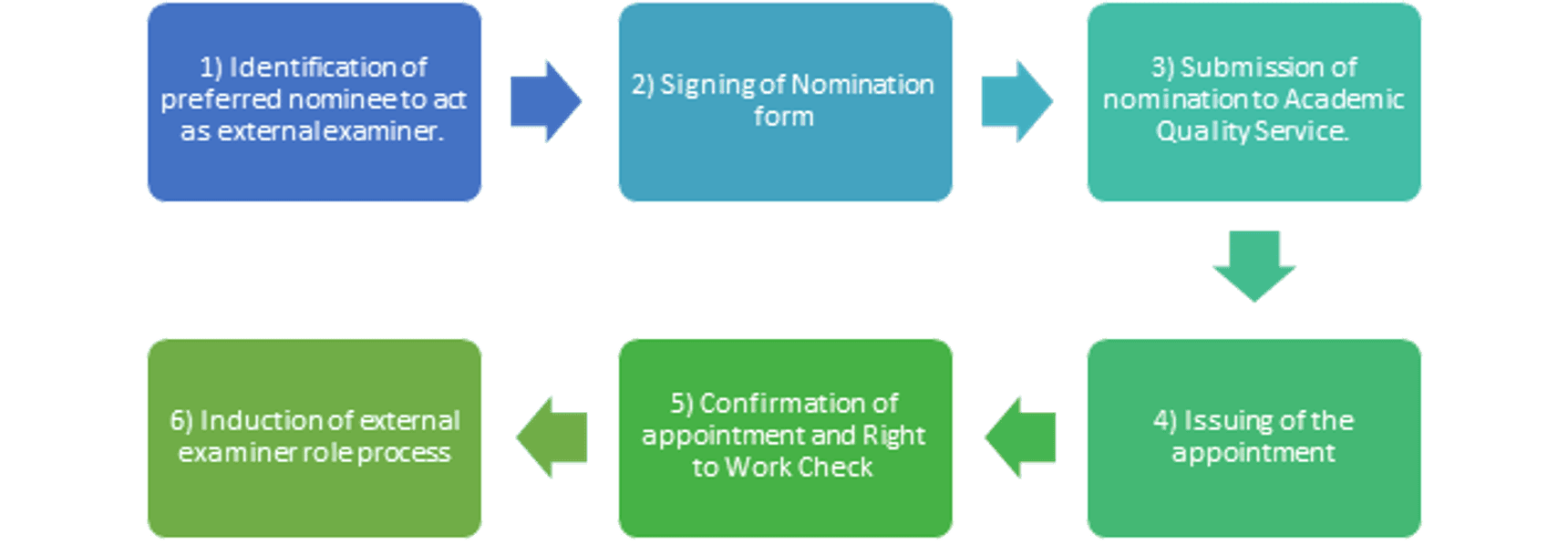
1. Identify a preferred nominee
The Programme Lead or Director of Programmes identifies a preferred nominee and arranges for the nomination form to be completed.
For provision delivered by a collaborative partner, the Institution Link Tutor identifies the nominee and submits the nomination to 番茄社区 University for approval.
A Director of Programmes may occasionally wish to nominate someone who does not fully meet the selection criteria. In these cases, the Director must provide a clear rationale to the Quality Manager (Externality) for approval. The Quality Manager may seek additional approval from the Director of Academic Quality Service.
2. Obtain signatures and approval
The Director of Programmes sends the signed nomination form to the Faculty Deputy Dean for approval.
For collaborative partner provision, the Institution Link Tutor must ask the head of the partner institution to sign the form. An authorised Institution Link Tutor may sign on their behalf.
The Institution Link Tutor then sends the form to the University Link Tutor for approval.
3. Submit the nomination to Academic Quality Service
The Faculty Deputy Dean sends the approved and signed nomination form to the Quality Manager (Externality) for processing.
4. Issue the appointment
The Quality Manager (Externality):
- reviews the nomination form
- checks for conflicts of interest or reciprocal arrangements
- prepares the appointment letter
- sends the appointment letter, acceptance form and supporting documents to the nominee.
5. Confirm the appointment and complete the right-to-work check
The nominee returns the acceptance form and their right-to-work documentation.
The External Examiner Team then verifies their eligibility to work in the UK.
Once the check is complete, the team:
- sends the new external examiner a link to the generic online induction
- informs the programme team that it can arrange the programme-specific induction.
6. Complete the induction process
The new external examiner completes the generic online induction. The programme team contacts them separately to arrange their programme-specific induction.
Changes to an appointment
Extension
Requests for exceptional extensions should be submitted well before the original appointment ends.
Late requests may result in the external examiner’s personnel record being closed. Reinstating the examiner on University systems may then cause delays.
Resignation
External examiners who wish to resign before the end of their appointment should provide at least six months’ notice.
Where possible, they should complete their duties for the current year. The Programme Leader and Director of Programmes should begin identifying a replacement immediately.
Termination
The University may terminate an external examiner’s appointment because of:
- failure to submit annual reports
- regular non-attendance at assessment boards
- failure to fulfil the duties set out in the University Regulations
- expiry of their eligibility to work in the UK
- a conflict of interest arising during the appointment, in which case the contract will end when the conflict arises
- withdrawal of, or failure to recruit students to, the relevant programme or programmes.